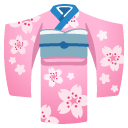
A wide-sleeved, wrap-front kimono, the emoji depicts traditional Japanese formal dress. It's used most for Japanese culture, festivals, and fashion specifically, though it occasionally gets stretched to represent any long, robe-like garment in a broader sense.
What 👘 means
A yellow full-length floral apparel designed with a small 'V' neck, a wide pair of sleeves that flare out at the end. The torso is designed with a broad black sash-like band that's tied with a yellow rope on top.
The 👘 Kimono emoji represents a gender-neutral traditional Japanese outfit. Since this attire is worn by all genders and classes, this emoji could signify a sense of unity, togetherness, and commonality apart from authentic Japanese clothing.
How and when to use it
- Are you asking someone to be honest? Or are you texting your bestie or any other confidante about how opaque someone is? In any of such cases, you could use 👘. How?! Scan to the next point.
- "If you want me to know know you, you gotta be an open kimono, man 👘" or "He's like this closed kimono 👘 Idk what's going on his head, and he wouldn't ever tell me".
- If you're posting or reposting pictures/videos of a kimono; one that you're wearing, a video of colorful kimono styles, etc, you can use 👘 in the caption.
- If you're sharing informative and educational content on Japanese culture and tradition, 👘 could be one of the emoji options.
Other Names
- 👘 Japanese Outfit
- 👘 Dressing Gown
- 👘 Japanese Dress
- 👘 Traditional Japanese Attire
- 👘 Morning Robe
- 👘 Gender-Neutral Robe
- 👘 Lounging Robe
- 👘 Robe de Chambre
👘 in real conversations
What does 👘 actually mean — is it a robe?
No, and that mix-up happens a lot from the flat design — 👘 shows a traditional Japanese kimono, a T-shaped robe tied with a wide sash called an obi, worn for weddings, tea ceremonies, and festivals rather than lounging around the house. A bathrobe doesn't have its own emoji, so 👘 sometimes gets misread as one at a glance.
When do people actually use 👘 in a caption?
Mostly tied to Japan directly — a trip there, a festival photo, cherry blossom season, or a post about Japanese culture generally. It shows up far less as a random fashion pick and far more as a specific, place-tied reference, closer to how a beret gets used for France than how a dress gets used for 'going out.'
What's the sash on the 👘 emoji actually called?
An obi — a wide fabric belt wrapped several times around the waist and tied into an elaborate knot at the back, doing real structural work rather than sitting there as decoration. That sash carries most of the garment's visual identity, which is probably why the emoji's design gives it so much weight.
The lowdown
- Category
- Objects › clothing
- Codepoints
U+1F458- Emoji version
- Emoji 0.6
- Shortcodes
:kimono:- Keywords
- clothing, comfortable, kimono
How it looks across platforms
Seeing a blank box instead of the emoji somewhere? Here's why that happens. Curious why the designs above don't match to begin with? Here's why that happens too.



⚡ Quick round
Which joined the keyboard first — 👘 Kimono or 🇵🇹 Flag: Portugal?