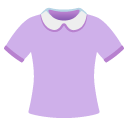
A short-sleeved blouse in soft purple, with a wide neckline and a visible brand tag, standing in for women's fashion generally rather than one specific garment. It shows up in shopping hauls, outfit-of-the-day posts, and clothing-store menus more than in ordinary conversation, functioning like a small clothes-rack icon.
What 👚 means
A casual lavender half-sleeved shirt, thigh-high in length, with a slightly wide 'U' neck that forms a 'V' at the bottom, the hind layer of which stitched with the brand tag.
The 👚 Woman's Clothes emoji represents casual dressing. It signifies leisure, casual occasions, comfort, and maybe even staying home. Nonetheless, this emoji is gender-neutral and can refer to a shirt/tee/blouse irrespective of the gender of the wearer.
How and when to use it
- Essentially, 👚 represents a woman's blouse that she would wear at a casual event. So, it could have a reference to plain tees, baggy tops, half sleeve shirts, etc.
- Setting aside the gendered label given to a piece of clothing 👚 could represent a half-sleeved shirt too. And with that comes the idea of casual dressing, hence this emoji could be used to indicate a 'casual dress code' in any context. For example, "Just come in casuals, man 👚 Please. No. No full-sleeved shirts".
- If you're talking about t-shirt dresses, generally worn by women and girls, 👚 could be a popup in the caption.
- You could also use 👚 in social media stories or posts about a colleague meetup or any semi-formal gathering that you're attending
Other Names
- 👚 Woman's T-Shirt
- 👚 Woman's Blouse
- 👚 Casual Wear
- 👚 Blouse
- 👚 Pink Shirt
- 👚 Woman's Shirt
👚 in real conversations
What does 👚 actually mean — is it a shirt or something else?
A blouse or fitted top, specifically — Unicode's own name for it is 'woman's clothes,' and the design shows a single fitted top rather than a full outfit. It gets used the way any top emoji would: an outfit-check caption, a new item just bought, or a 'what should I wear on top' kind of text.
When does 👚 usually show up in a text?
Wardrobe planning, mostly — deciding what to wear, showing off a new top, or building out an outfit description alongside 👖 or 👗. It's a smaller, more specific piece than a full look, so it tends to appear when the conversation is genuinely about one garment rather than an entire outfit.
Is 👚 the same as 👕 in how people use it?
Not quite — 👕 is a plain t-shirt, unisex and casual, while 👚 is a fitted, feminine-cut top, closer to a blouse. Someone captioning a basic tee reaches for 👕; someone captioning a going-out top or a work blouse reaches for 👚 instead, even though both technically just mean 'shirt.'
The lowdown
- Category
- Objects › clothing
- Codepoints
U+1F45A- Emoji version
- Emoji 0.6
- Shortcodes
:womans_clothes:- Keywords
- blouse, clothes, clothing, collar, dress, dressed, lady, shirt, shopping, woman, woman’s
How it looks across platforms
Seeing a blank box instead of the emoji somewhere? Here's why that happens. Curious why the designs above don't match to begin with? Here's why that happens too.



⚡ Quick round
Which joined the keyboard first — 👚 Woman’s Clothes or 🫄 Pregnant Person?