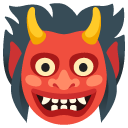
Red-faced, horned, with a wide mouth and shaggy hair, the ogre emoji is drawn from the oni of Japanese folklore. The oni ranges from purely menacing to a mischievous prankster depending on the story, and the emoji gets used for anything scary, monstrous, or over-the-top villainous, plus a seasonal boost every Setsubun, when Japan tosses beans to drive the oni out.
What 👹 means
A red, hairy face with big eyes, a giant nose, and a grinning mouth with vampire-like teeth and fangs. This face also has two red horns on top of the head.
Referring to the Oni Ogre of Japanese mythical folklore, the 👹 Ogre emoji signifies the act of 'warding off evil' or even scolding children for bad behaviour.
With an evolutionary meaning, the supernatural figure of the ogre now owns positive suggestions such as protection to an extent. It can also have a patriarchal connotation, given its modern-day use.
How and when to use it
- You can use this emoji in Japanese traditional contexts such as calling someone an ogre if they don't look like either of their parents.
- This emoji can also be used to show a terrifyingly protective vibe in a conversation.
- Although not as cute as Shrek, this emoji can still be modernized into a funny and sarcastic context.
- If you're trying to virtually scare someone over text, send this emoji randomly out of the blue.
- Since this ogre is also adorned as a mask, you can use this emoji in instances where you feel like a person or a situation is wearing a mask.
- You can also send this emoji while trying to express that there's more to something than what you know of.
Other Names
- 👹 Oni
- 👹 Oni Mask
- 👹 Red Devil
- 👹 Protection
- 👹 Masked
- 👹 Fake
- 👹 Red Monster
- 👹 Scary
- 👹 Supernatural
- 👹 Demonic
- 👹 Ward Off Evil
- 👹 Red Face Mask with Horns
👹 in real conversations
What's behind Japan's tradition of throwing beans at people wearing this face?
It's Setsubun, the festival marking the start of spring, where families toss roasted soybeans while shouting "oni wa soto, fuku wa uchi" — demons out, luck in. 👹 draws directly on the oni it depicts, so the emoji gets a seasonal bump every February around that tradition, even in feeds well outside Japan.
Is 👹 always meant to be scary?
Not entirely — the oni in Japanese folklore started out as pure menace but picked up a more mischievous, even protective streak over centuries of retelling. Online, 👹 mostly stays on the scary-monster side of things: jump scares, over-the-top villain jokes, Halloween posts, rather than anything genuinely sinister.
What does 👹 mean when someone calls their dad that?
Usually an exaggerated complaint about strictness, not an actual insult — "dad's being a 👹 about my curfew" plays up parental sternness for comic effect. It borrows the oni's old reputation for scolding bad behavior in Japanese folklore, stretched into a joke about being grounded rather than anything genuinely hostile.
The lowdown
- Category
- Smileys & Emotion › face-costume
- Codepoints
U+1F479- Emoji version
- Emoji 0.6
- Shortcodes
:japanese_ogre::ogre:Discord- Keywords
- creature, devil, face, fairy, fairytale, fantasy, mask, monster, ogre, scary, tale
How it looks across platforms
Seeing a blank box instead of the emoji somewhere? Here's why that happens. Curious why the designs above don't match to begin with? Here's why that happens too.



⚡ Quick round
Which joined the keyboard first — 👹 Ogre or 🕦 Eleven-thirty?
Runs with a crowd
👹 keeps company in skull emojis — tap-to-copy sets for when one emoji isn't enough.