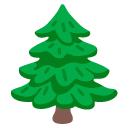
A tall conifer that keeps its green needles year-round, this emoji covers pine forests, camping trips, and mountain scenery. Its name also lent itself to marketing language — 'evergreen content' stays relevant no matter when someone reads it, the same way this tree never goes bare.
What 🌲 means
A full stature fern tree with flourishing green leaves that are shaped in the form of a cone, with a short brown bark at the bottom. Apart from lush greenery, it also expresses feelings of freshness and peace.
The 🌲 Evergreen Tree is mostly used to represent a Christmas Tree, thus symbolizing the spirit of Christmas and the whole Christmassy vibe. It can be used to signify both evergreen trees and evergreen conifers.
How and when to use it
- If you're sharing a picture that has the background of coniferous trees, then you can use 🌲 in the picture caption if the background is one of the main highlights of the image.
- Since evergreen trees do not or rarely shed leaves, you can use 🌲 to resonate with that kind of immortality in post captions. For instance, if you're sharing a picture of your grand mum or even that of a celebrity who only grows youngers by the years, you can use this emoji in such captions; essentially "evergreen style" or "evergreen beauty", etc.
- You can also use 🌲 while posting pictures that have loads of greenery and trees, irrespective of whether there's an evergreen tree in the lot.
- Speaking of Christmas, use 🌲 while sharing all those eye-blessing pictures of your Christmas decor and other Christmas preps!
- If you're a page solely dedicated to trees; tree photography, and other informative content about these green guys, then you can use 🌲 in your social media profile name as well.
Other Names
- 🌲 Evergreen Conifer
- 🌲 Green Tree
- 🌲 Christmas Tree
- 🌲 Pine Green
- 🌲 Fir Tree
- 🌲 Coniferous Tree
- 🌲 Cedar
- 🌲 Spruce
- 🌲 Douglas Fir
🌲 in real conversations
What's the real difference between 🌲 and 🌳?
Shape and season — 🌲 is a cone-shaped conifer that keeps its needles green all year, while 🌳 is a round, broad-leafed tree that loses its leaves in fall. 🌲 leans toward forests, mountains, and pine-country posts even though there's a separate tree for Christmas (🎄); 🌳 leans toward parks, shade, and everyday neighborhood scenery.
Does 🌲 ever get used for Christmas even though 🎄 exists?
Sometimes, mostly in captions about pine forests, tree farms, or a hike through actual conifers rather than the decorated tree in someone's living room. 🎄 is the one built specifically for a trimmed, ornamented Christmas tree with lights strung on it; 🌲 stays closer to the plain, undecorated version you'd see growing wild.
What does 🌲 mean in a travel or outdoorsy caption?
Mountains, camping, the Pacific Northwest — 🌲 fits anything evergreen-forest-coded: national parks, road trips through pine country, a cabin weekend. It carries a slightly wilder, more remote feeling than 🌳, which reads more like a tree you'd walk past on a city sidewalk than one you'd hike into.
The lowdown
- Category
- Animals & Nature › plant-other
- Codepoints
U+1F332- Emoji version
- Emoji 1.0
- Shortcodes
:evergreen_tree:- Keywords
- christmas, evergreen, forest, pine, tree
How it looks across platforms
Seeing a blank box instead of the emoji somewhere? Here's why that happens. Curious why the designs above don't match to begin with? Here's why that happens too.



⚡ Quick round
Which joined the keyboard first — 🌲 Evergreen Tree or 🗡️ Dagger?
Runs with a crowd
🌲 keeps company in green emojis — tap-to-copy sets for when one emoji isn't enough.